
Story architecture, visual system, modular slide patterns, iconography direction, information hierarchy, capability layouts, and final QA.
Presentation Design · Growth Marketing · Brand Systems · Information Architecture
Turning Aretum’s broad technical portfolio into a clear, scalable capability story.
I structured Aretum’s 29-slide Overview & Core Capabilities deck as a modular business-development narrative—moving from brand promise and proof points into markets, services, projects, vehicles, and a clear next step.
The work combined visual design, marketing strategy, UX-style information architecture, technical content simplification, and repeatable presentation patterns. My broader Aretum responsibilities across growth marketing, web, and contract proposal work helped me design for reuse across business-development touchpoints.

29 slides
4 capability pillars
Business development narrative
Project overview
The deck needed to communicate breadth without making Aretum feel fragmented.
The source presentation spans vision and values, company proof points, leadership, markets and customers, four core capability areas, certifications, products, representative projects, contract vehicles, partnerships, and contact information. I organized that breadth into a coherent visual narrative.
Growth marketing, web, and proposal experience informed a presentation designed for client, partner, capture, and marketing conversations.
Digital Transformation, Data Intelligence, Cybersecurity, and Mission Support form the central capability architecture.
A polished, reusable business-development tool that establishes credibility, simplifies technical breadth, and supports next-step conversations.
The communication challenge
How do you make a complex service portfolio feel understandable without flattening the expertise?
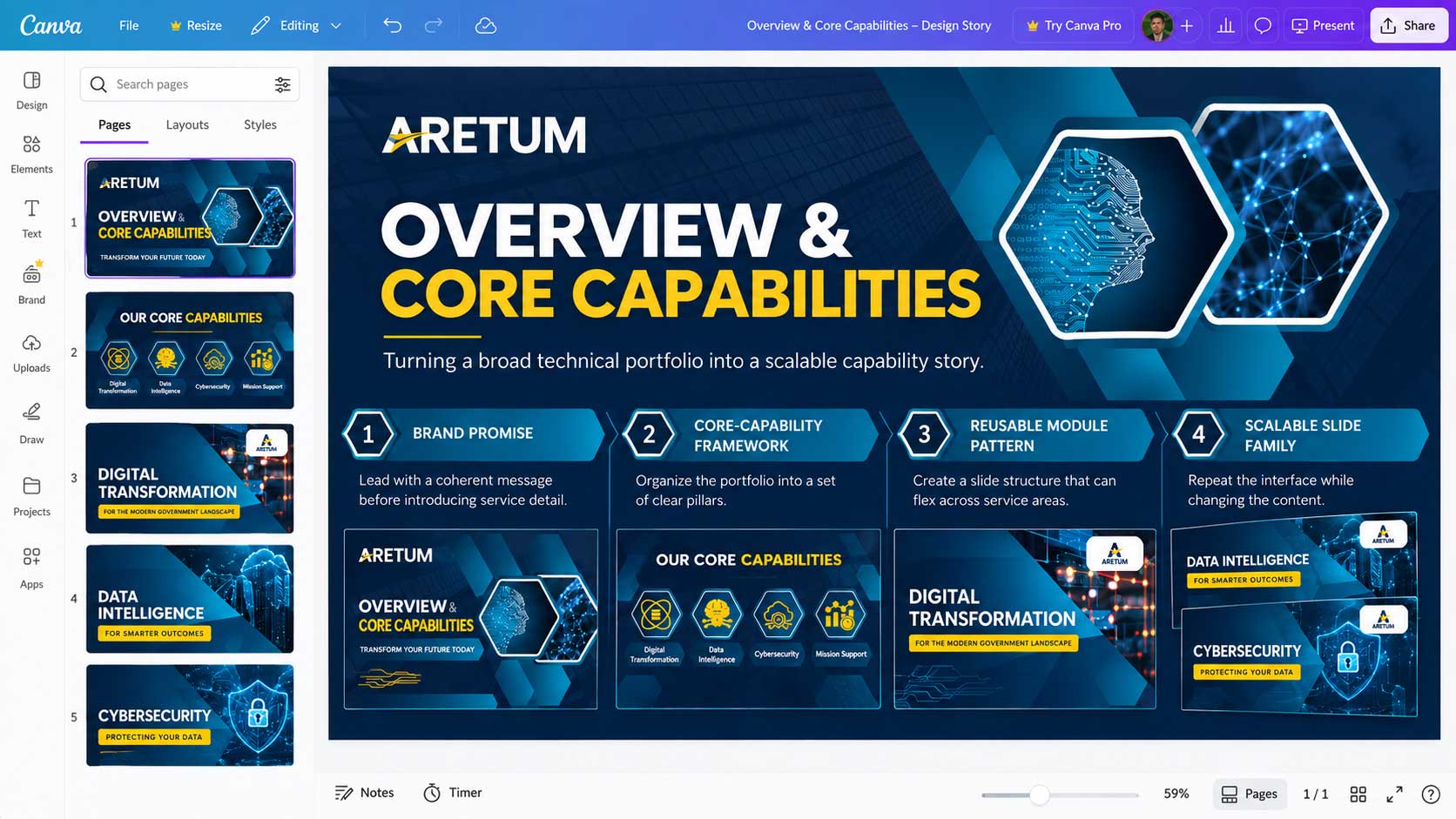
I treated the deck like a content-rich interface: establish orientation, reveal information in layers, reuse familiar patterns, and keep the user focused on the current decision.
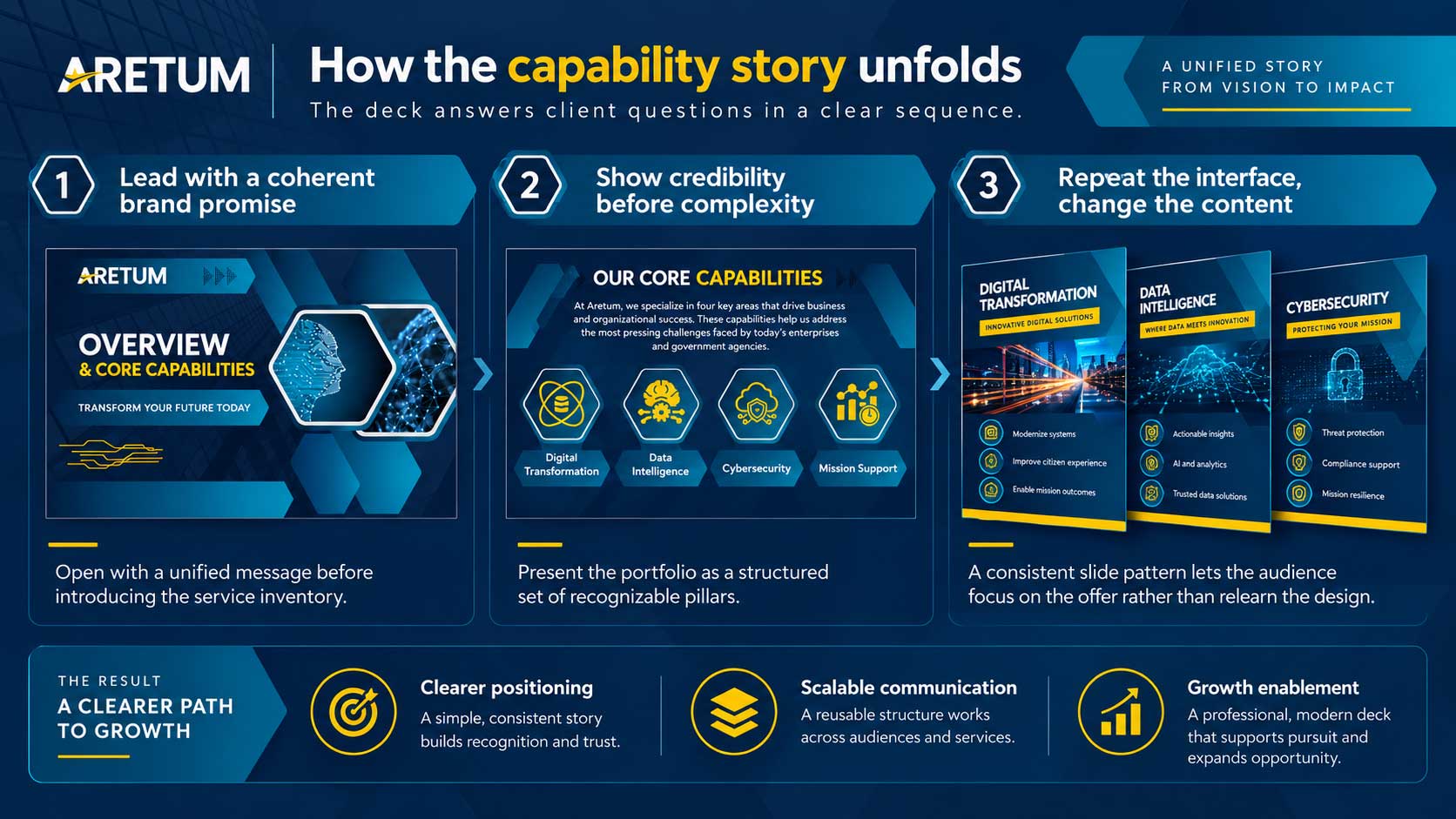
Lead with a coherent brand promise
Vision, values, highlights, and “Why Aretum?” create context before the audience reaches detailed technical offerings.
Show credibility before complexity
Leadership, markets, agency relationships, projects, certifications, and vehicles work as evidence that supports the capability story.
Repeat the interface, change the content
Each capability section uses a familiar module so Digital Transformation, Data Intelligence, Cybersecurity, and Mission Support can be compared without relearning the layout.
Process + cross-functional thinking
I organized the work around content architecture first, then visual expression.
That sequencing kept design decisions tied to the business-development job each slide needed to perform.
- 01
Audit the content
Map vision, proof points, leadership, markets, capabilities, products, projects, vehicles, and closing content into a clear inventory.
- 02
Define the narrative
Sequence the story from who Aretum is → why it matters → what it does → where it has delivered → how to engage.
- 03
Systemize the modules
Build reusable capability, proof-point, profile, project, and technical-detail patterns instead of styling every slide independently.
- 04
Refine + govern
Check hierarchy, spacing, asset quality, brand alignment, density, accessibility, and consistency across the full 29-slide system.
Reusable presentation design system
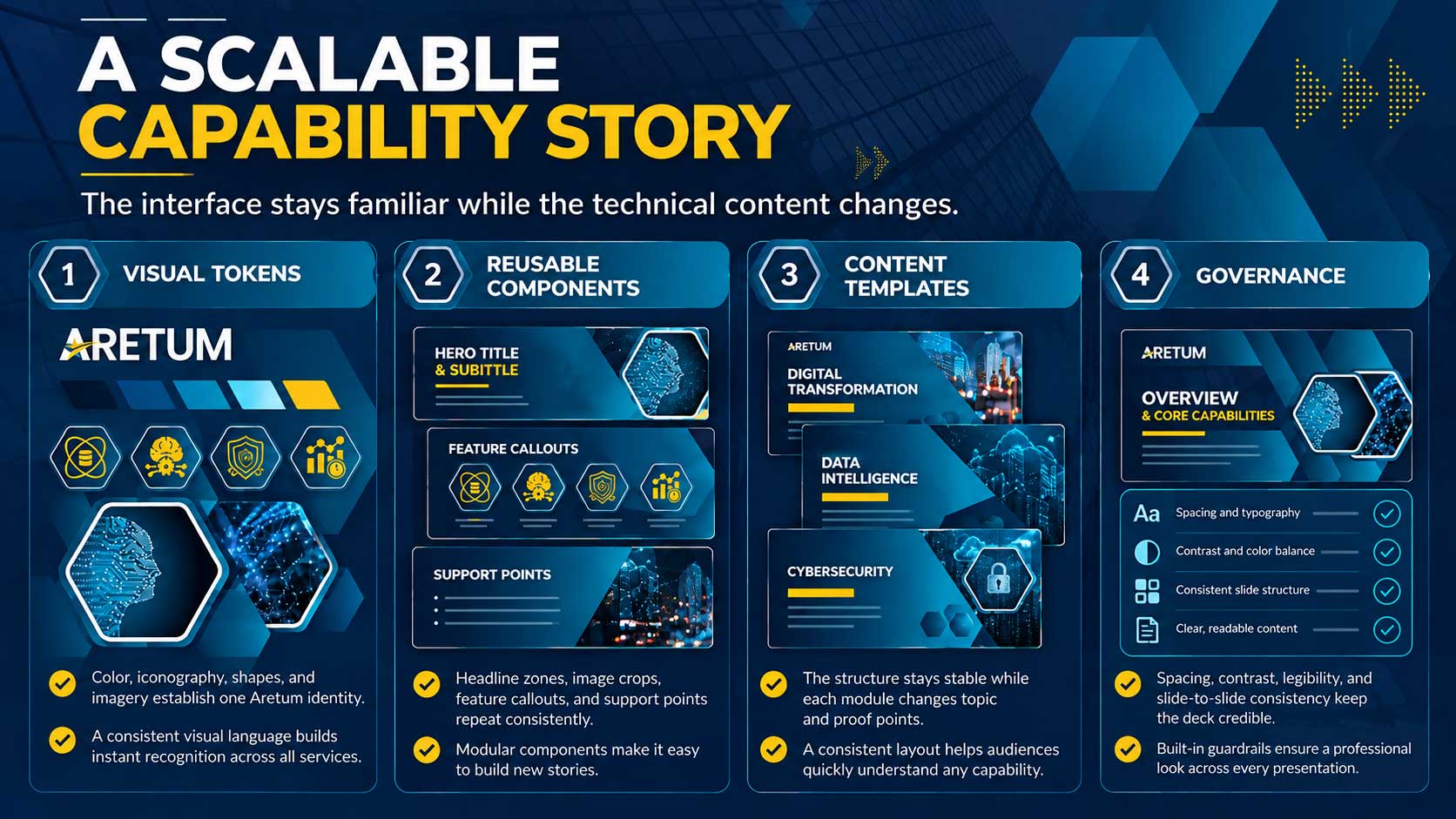
The capability story scales because the interface stays familiar while the technical content changes.
The case study now makes the system layer explicit: tokens, components, patterns, content rules, and QA. That is the design-system depth a recruiter should be able to identify without inferring it from polished slides alone.
Enterprise-design-system connection:
This presentation is not an enterprise software design system. It demonstrates the same scalable behaviors—shared rules, repeatable components, content-model separation, governed assets, and consistency across a large communication artifact.
Visual tokens
Brand color, contrast, spacing, type roles, icon treatment, imagery, and recurring accent behaviors stay consistent.
Reusable components
Capability headers, key-component blocks, leader profiles, proof points, project stories, and call-to-action structures repeat.
Content templates
Each technical capability follows a recognizable sequence so audiences can compare services without relearning the page structure.
Governance
Asset reuse, naming, slide consistency, density checks, hierarchy, accessibility, and presentation preflight protect quality at scale.
/Slide1.JPG)
/Slide3.JPG)
/Slide9.JPG)
/Slide12.JPG)
/Slide14.JPG)
Marketing + growth storytelling
I designed the narrative to answer the questions a prospective client or partner is likely to ask in sequence.
The presentation moves from orientation and credibility into technical capability, then into evidence and access—mirroring a business-development conversation rather than a catalog.
- Who are you? Vision, values, highlights, and leadership establish identity.
- Can you deliver? Markets, customers, certifications, projects, and vehicles provide proof.
- What can you solve? Four capability pillars organize technical breadth into recognizable service families.
- What happens next? Contract vehicles, partnerships, and contact information keep the story actionable.
/Slide10.JPG)
01 · DIGITAL TRANSFORMATION
One module, clear service hierarchy
Human-centered design, agile development, cloud, and customer experience are grouped into a scan friendly structure.
02 · DATA INTELLIGENCE
Technical depth without visual overload
Analytics, AI/ML, visualization, and governance are separated into recognizable information blocks.
03 · CYBERSECURITY
Consistent pattern, different content
The repeated interface lets the audience focus on the security offer rather than relearning the slide design.
Interactive deliverable
View the complete Overview & Core Capabilities deck in PowerPoint Show mode.
The case study explains the design system and narrative decisions; the PPSX gives reviewers the finished presentation experience.
Browser behavior varies. The PowerPoint Show may open in desktop PowerPoint or download for local viewing.
End goal + accomplishment
The finished deck makes a large service portfolio feel like one coordinated brand and one navigable story.
Clearer positioning
The narrative establishes identity and credibility before asking the audience to absorb detailed technical capability information.
Scalable communication
Reusable slide patterns make the presentation easier to extend and keep consistent as capabilities, projects, or proof points evolve.
Growth enablement
The artifact supports business-development conversations with a structured path from brand promise to evidence, offerings, and engagement.
Design value